

In today’s world freelancing is a popular way to earn a living in India. Many people are doing jobs like designing and writing, creating websites, marketing products online and helping people with search engines. Some even make videos for a living.
These freelancers work on their own, get paid online and enjoy the freedom to work from anywhere, choose their hours and work with people from other countries. When their income grows they might wonder if they need to register for Goods and Services Tax or GST in India.
Some people think that the Goods and Services Tax is for big companies while others think that freelancers do not need to have it. You have to sign up for the Goods and Services Tax based on how much money you make the people you work with and the kind of freelance work you do.They are not working for them all the time like a regular employee.
When you work on projects and get paid directly by clients the government sees you as a service provider, under GST law. Freelancers include designers, developers, writers, marketers, photographers, social media managers, consultants and many other professionals.
Even working from home the government considers freelancing a business. Its essential to understand GST when your freelance income grows and you have to pay GST on it. You have to pay GST on your freelance income.
What is GST Registration?
When you start a business in India you need to register for the Goods and Services Tax. This is like getting an identity for your business. Once you are registered you get a number called the GSTIN. This number is important because it lets you make invoices that include the Goods and Services Tax and you can also collect the Goods and Services Tax from your clients when you need to.
Then you have to send this information to the government when you file your Goods and Services Tax returns. A lot of people who work there think that the Goods and Services Tax is the same as income tax.
When is GST Registration Mandatory for Freelancers?
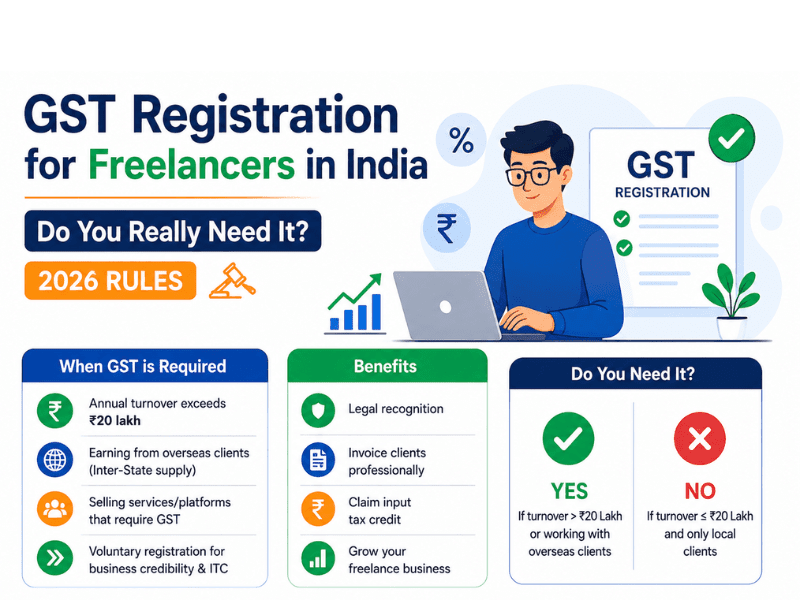
According to the rules in India for 2026 you need to register for GST mainly when your annual turnover crosses a certain limit. For states in India if your total income from freelancing exceeds ₹20 lakh in a financial year then GST registration is usually compulsory.Here turnover means your revenue before you deduct any expenses.
For example if you earn ₹22 lakh, from projects in one year as a freelancer then you may need to register for GST.However turnover is not the thing to consider. Some freelancers who work with business clients or international clients may still. Choose to register for GST even before they reach the limit.
GST for International Freelance Clients
So a lot of freelancers want to know if they have to pay GST when they work with clients from countries. If you use websites like Upwork or Fiverr to find work with people from countries the government considers this an export of services.
The good thing is that when you export services you usually do not have to charge GST to your clients from countries as long as you follow the rules. This means that GST is not really a problem for people who work with clients.
A lot of freelancers still decide to register for GST because it makes their invoices look more professional and it helps them follow the law. It also makes it easier to work with clients from countries.
Benefits of GST Registration for Freelancers
Lots of people who do freelance work think that getting a GST registration is more paperwork.. It is actually really helpful. One big advantage is that it makes you look more professional. When you are a freelancer with a GST registration you seem serious and people can trust you. This is especially true for companies and agencies.
They like to work with freelancers who have a GST registration because they can get back the tax they paid. You can also get back the tax you paid on things you bought for your work. This is called input tax credit.
So if you buy a laptop or some software or pay for a website you can get back the tax you paid on those things. Having a GST registration is also good because it helps you set up your business in a professional way.
When Freelancers May Not Need GST Registration
Not every freelancer in India needs to register for GST. If you earn less than an amount each year and mostly work with small clients in India you may not need to register for GST.
For instance if you are a content writer earning ₹4 lakh per year or a part-time designer earning ₹7 lakh per year you can continue freelancing without GST registration.
Many freelancers start small. Get registered later when their business grows.
This is perfectly okay. Even if you do not need to register for GST it is still important to keep records of your invoices, payments, contracts and finances.
GST Return Filing for Freelancers
When you are a freelancer and you become GST registered you have to do return filing as part of the things you must do. A lot of people are really scared of this part. Filing GST returns is not as hard as it used to be. The GST returns have information about the invoices you send, the money you make, the taxes you collect and the tax credits you can get.
The kind of registration you have will decide if you have to file returns every month or every few months. Many freelancers get an accountant or a tax consultant to help them with filing because it saves them a lot of time and helps them avoid mistakes.
Penalty for Ignoring GST Registration
If a freelancer has to get a GST registration but they do not do it they may have to pay penalties on. The government can charge the freelancer fines or extra taxes or interest in some cases. A lot of freelancers do not get a GST registration at first because they think the government will not notice the payments they get online.
Later on when the bank checks their account or when they have to give their income tax details they have problems. It is easy to track payments and payments from companies now because everything is digital. This is why freelancers should learn the GST rules of ignoring them.
If freelancers follow the rules they can build a safer business. GST registration is important for freelancers. They should take it seriously. Following the GST rules helps freelancers to have a business foundation.
Should Freelancers Take Voluntary GST Registration?
When you do not have to register for GST, some people who work on their own still decide to do it. This is because they think about what they want to achieve with their business in the future. People who want to work with companies or get clients from other countries often want to register for GST early on.
They want to look professional and make an impression. Registering for GST voluntarily can make your business look more organized and reliable. It also helps you keep track of your money properly which can be helpful when you need a loan or want to work with someone.
Conclusion
GST registration for freelancers in India is not that confusing.The key thing is to know your earnings, who your clients are and how your business is set up. If you are a freelancer with limited income you might not need GST registration right away.
If you are growing or working with big clients it is better to register early. The thing is, people often fear GST but it is not that scary once you understand it. Freelancing is really taking off in India. So it is very important to handle your money and follow all the rules.
Whether you are just starting out with freelancing. You already have a business knowing the GST rules can really help you stay out of trouble later on and make your professional life with freelancing stronger.